
What Can Migratory Birds Tell Us About the Environment?
November 13, 2026Since ancient times, human communities around the world have observed birds and interpreted signs of nature through their behaviour. Their songs, movements and seasonal appearances have long been associated with changes in the weather, the arrival of visitors or the onset of new seasons. In much the same way, modern science studies biological rhythms to detect environmental changes. This knowledge helps us better understand ecosystems, identify environmental disturbances and develop strategies for their conservation.
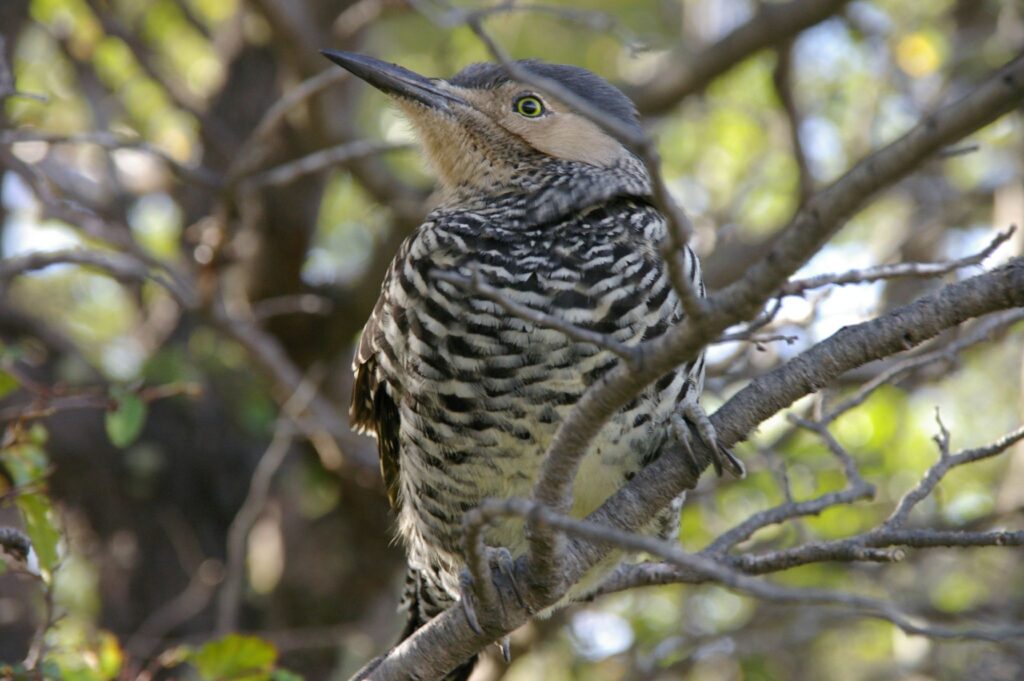
Pitío (Colaptes pitius). ©Ben Tubby
Birds as Messengers
It is said that the presence of a Chilean Flicker (Colaptes pitius), locally known as the pitío, heralds the arrival of a visitor (Deumacán, 2009). According to this belief, someone travelling from distant lands would “send their pitío ahead” to announce that they are about to arrive. In some interpretations, if the bird sings for three consecutive days, it may foretell a death. Stories like those surrounding the pitío reveal how communities have developed a keen ability to observe nature’s cycles over generations. The presence or absence of a bird, its song or its behaviour can all become signs that something is changing in the surrounding environment. In a way, modern science has found a connection with this ancient way of observing the natural world.
Birds are highly responsive to the conditions of the ecosystems they inhabit. Temperature, precipitation, snowfall, daylight, the intensity of the electromagnetic field, the availability of insects, fruits and seeds, and even the presence of water can influence where they live, when they breed and when they begin their movements from one place to another. For this reason, observing when a bird arrives, begins to sing, builds its nest or disappears from a particular area can provide valuable information about what is happening in the environment.
The relationship also works in the opposite direction: environmental changes can influence when birds arrive at their breeding grounds or begin their migrations. This does not mean that a single observation is enough to explain a change in climate. However, when observations are repeated over many years and systematically recorded, they can reveal trends and shifts in natural cycles.
Migratory Birds and Biological Rhythms
Migratory birds are part of large-scale ecological cycles and bring together information from different ecosystems, making them particularly valuable bioindicators. Their movements are not random: they are linked to biological and environmental rhythms that recur, with some variation, year after year.
In Aysén, September and October mark the arrival of numerous migratory species. This is when they begin to settle into their territories, sing, breed and build their nests. Much of their reproductive activity takes place during November, December and January. Then, around February and March, young birds begin to become independent, adults go through their moulting period, and some species start gathering in large flocks. With the arrival of autumn, between April and May, many birds leave Aysén and move to other regions. Some travel to central and northern Chile; others cross the Andes, while some undertake extraordinary journeys to the Amazon and other parts of South America.
Taking these biological rhythms as a starting point, Fundación Kreen studies and monitors birds in the Meullín-Puye Nature Sanctuary through field observations and the use of specialised sensors. All this information is analysed using computer programs and algorithms that allow us to study biological patterns in birds. We also draw on citizen science data from platforms such as eBird, as well as data from public institutions.
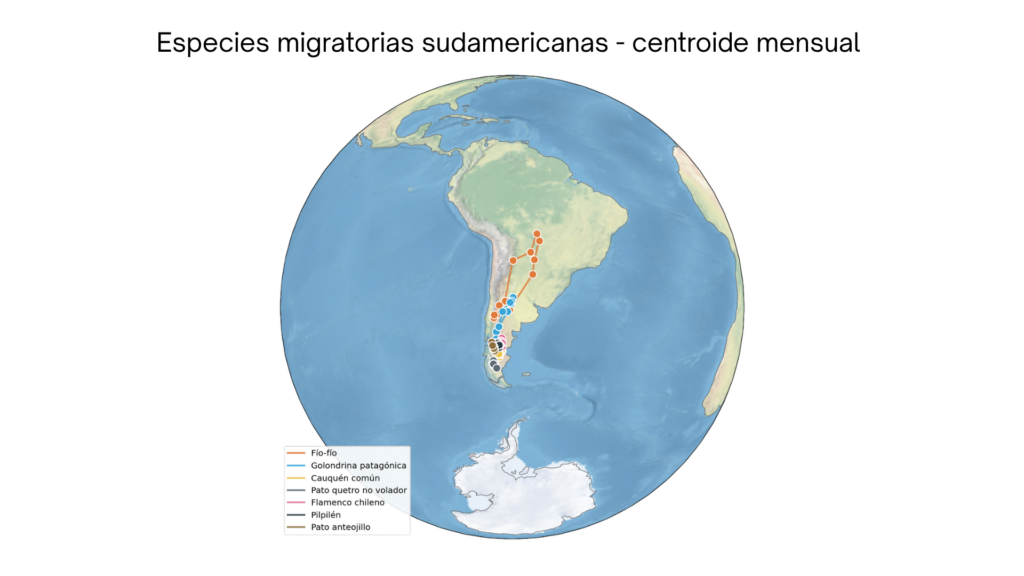
As part of this work, Fundación Kreen has implemented a computer program originally written in the Wolfram language (Thiel, 2026), which calculates monthly population centroids for bird species in the Northern Hemisphere. Centroids indicate where a bird population is concentrated at a given time. However, they do not show the routes taken by individual birds, meaning they do not represent actual flight paths and tend to underestimate flight distances. Instead, they provide illustrative hemispheric migration routes, biological calendars and other useful data for studying bird movement patterns. Fundación Kreen’s version involves reimplementing this method in Python, adapting it for application to the study of birds in Chile and Patagonia.
The program can generate routes by connecting monthly centroids with circular arcs, from December through January. This makes it possible to represent migration patterns at both regional and hemispheric scales. At the regional scale, the centroids of some species of interest shift between 43 and 140 km per year. It is also possible to distinguish migratory species from those that remain in Aysén year-round by measuring their latitudinal displacement in degrees. For example, the fiofío (21°) and the swallow (11°) show considerably greater latitudinal shifts than resident species such as the Austral Thrush and Thorn-tailed Rayadito (1° and 2°, respectively). The following figure illustrates the hemispheric routes traced by monthly centroids calculated using GBIF data.
Phenology and Biological Calendars: Patterns Revealed by the Data
Centroids therefore allow us to observe how a species and its distribution shift throughout the seasons. This information is useful for studying phenology, the science that examines recurring biological events in living organisms and their relationship with environmental conditions. By comparing centroids across different months, we can identify behavioural patterns and develop biological calendars showing when and where the main seasonal movements of populations take place. Biological calendars are therefore a tool for observing, recording and understanding how living organisms respond to the seasons and changing environmental conditions.
In birds, biological calendars can include arrival and departure dates in a given territory, breeding periods, the appearance of juvenile birds, moulting, flock formation and changes in the abundance of particular species. The following figure shows a calendar of confirmed bird detections in Aysén, indicating the percentage of visits in which each species was recorded per month (n = number of valid visits per month) between 1996 and 2026.
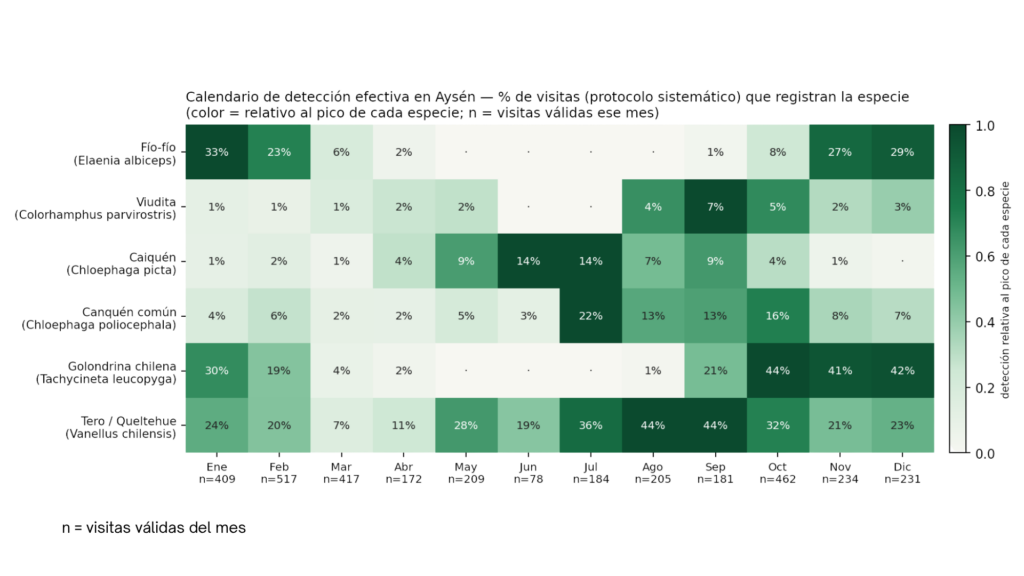
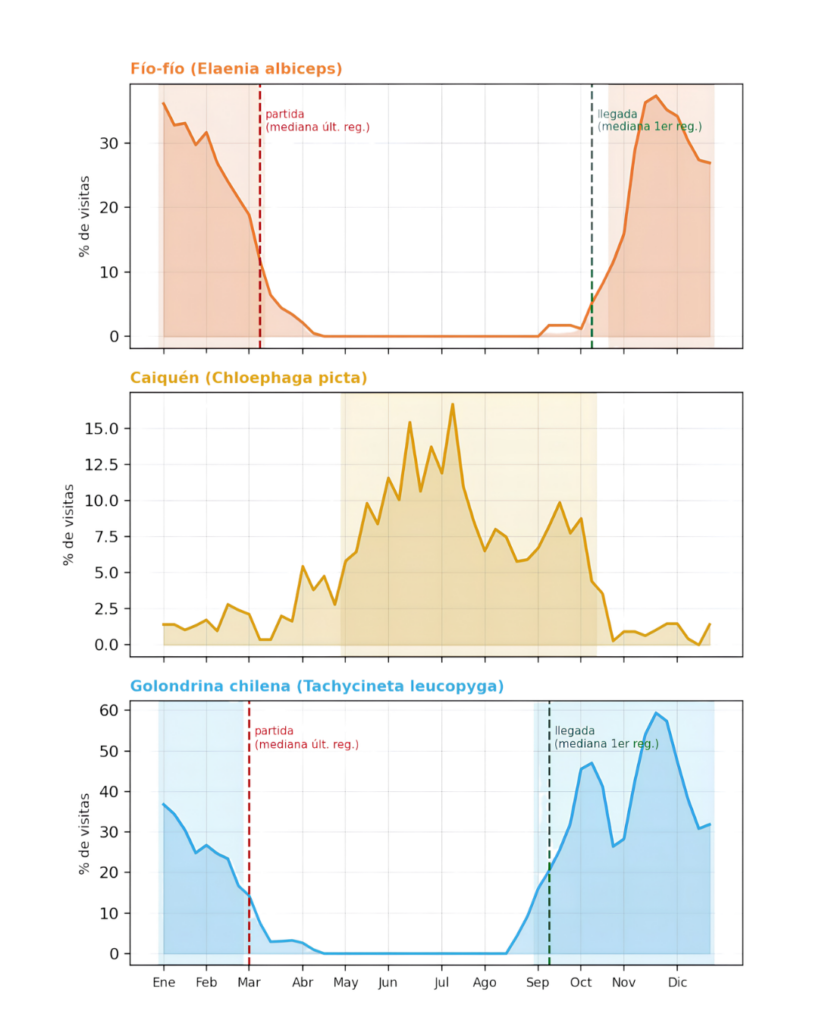
The timing of flock or individual bird arrivals and departures can vary due to climatic conditions, changes in body condition or other, as yet unknown, factors. Based on 3,299 valid bird observation records, the Chilean Swallow, the fiofío and the Spectacled Tyrant appear in spring and disappear in autumn. Records of the Upland Goose (Caiquén) confirm a different seasonal pattern, with higher numbers during winter, peaking in June and July and reaching their lowest levels in April. Large flocks of between 80 and 100 birds have also been recorded in February and March.
The Ecological Perspective of Biological Calendars
Bird migrations are among nature’s most spectacular phenomena, reminding us that our planet is constantly in motion in many different ways. Birds have remarkable ways of travelling and navigating their routes, guided by a subtle interplay of environmental cues that allows them to detect the rhythms of the ecosystems they inhabit, including light, food availability, the electromagnetic field and temperature.
A biological calendar also helps us understand that bird movements bring about changes in the ecosystems that receive thousands or even millions of birds arriving from distant places. The fiofío, for example, plays an important role as a seed disperser in Patagonian forests. Its high degree of migratory connectivity between Patagonia and regions such as the Atlantic Forest means that it helps link biodiversity and ecosystem functions across distant regions.
Some spring arrivals of migratory birds coincide with the appearance of the first fruits and flowers, or with the emergence of flying insects that provide them with food. Upland Geese and Ashy-headed Geese gather in large flocks in February and March, as well as during winter. These species show considerable migratory flexibility, which is why their populations have been classified as resident, partially migratory or migratory, rather than treated as a single, static unit. Both steppe and coastal habitats are particularly important for the conservation of this group of birds.
Observing to Understand
Today, science has tools that allow us to take our observations of nature even further. Geolocators, bird counts—such as those conducted by the Citizen Observer Network (ROC)—monitoring programmes and databases help reconstruct migration routes and understand how different ecosystems are connected through birds. Yet the starting point remains the same as it was generations ago: to look, to listen and to pay attention to what is happening in the surrounding landscape.
References:
Deumacán, Wilma (2009). Wera Wenu Werken (Mensajeras Del Cielo).
Thiel, M. (2026). BirdFlightPaths (Versión 1.0) [Software de computación]. GitHub. https://github.com/mthiel74/BirdFlightPaths
Fundación Kreen (2026). BirdFlightPaths Aysén: adaptación en Python del método de centroides poblacionales de Thiel (2026) para aves de Aysén, Chile [Código]. Elaborado con asistencia de Claude (Anthropic).
Bauer, S., y Hoye, B. J. (2014). Migratory animals couple biodiversity and ecosystem functioning worldwide. Science, 344(6179), 1242552.
Bravo, S. P., Cueto, V. R., y Gorosito, C. A. (2017). Migratory timing, rate, routes and wintering areas of White-crested Elaenia (Elaenia albiceps chilensis), a key seed disperser for Patagonian forest regeneration. PLoS ONE, 12(2), e0170188. https://doi.org/10.1371/journal.pone.0170188
Chesser, R. T. (1994). Migration in South America: An overview of the austral system. Bird Conservation International, 4(2–3), 91–107. https://doi.org/10.1017/S0959270900002690
Dingle, H. (2008). Bird migration in the southern hemisphere: A review comparing continents. Emu, 108(4), 341–359.
Raimilla, V (2021). Aves de las turberas de la región de Aysén. Capítulo 10: Aves de las turberas de la región de Aysén, Chile. En: Domínguez, E., & Martínez, M.P. (eds.) 2021. Funciones y servicios ecosistémicos de las turberas de Sphagnum en la región de Aysén. Colección libros INIA Nº 41. Instituto de Investigaciones Agropecuarias. Centro Regional de Investigación Tamel Aike. Coyhaique, Chile. 344 pp.
Pedrana, J., Pütz, K., Bernad, L., Seco Pon, J. P., Gorosabel, A., Muñoz, S. D., Rojas, P. (2018). Migration routes and stopover sites of Upland Geese Chloephaga picta in South America. Avian Biology Research, 11(2), 89–99.
Medrano, F., Barros, R., Norambuena, H. V., Matus, R., & Schmitt, F. (Eds.). (2018). Atlas de las aves nidificantes de Chile. Red de Observadores de Aves y Vida Silvestre de Chile
Other news
Second Edition of Charlas Kreen Brings Together Puerto Aysén’s Educational Community for a Science and Environmental Outreach Event

Science and Local Knowledge Come Together to Explore the Medicinal Potential of Aysén’s Native Flora